Content Marketing Strategy in 2026: A 7-Step Framework That Compounds

"Content marketing strategy" and its close variants draw well over 100,000 US searches a month, which tells you something uncomfortable: an enormous number of teams are still looking for the plan they should already be running. Most of them do have a calendar. What they do not have is a strategy — a documented argument for why these topics, in this order, for this audience, measured this way.
The gap matters more in 2026 than it did five years ago. AI answers now sit between the query and your page, buying committees research anonymously, and publishing volume has stopped correlating with growth. The seven steps below are the framework we run for clients, in the order we run them. If you want the whole thing operated for you, our plans and pricing show what that costs.
Step 1: Define one audience and one commercial outcome
Strategies fail at the first step far more often than at the last. A brief that says "marketers and founders" produces content that is useful to neither, because the two groups ask different questions and judge answers by different standards.
Pick the single audience closest to revenue, then write down the commercial outcome you expect content to influence — demo requests, qualified pipeline, trial activations. Every later decision is settled by reference to that sentence, which is precisely what makes it worth the twenty minutes it takes to write.
Step 2: Audit what you already have
Before commissioning anything new, inventory every published URL against four columns: traffic, conversions, last updated, and whether it still reflects reality. Most libraries split roughly into a small group that earns almost everything, a middle group that is one refresh away from working, and a long tail that quietly drags the domain down.
Refreshing a page that already has authority is typically three to five times cheaper per unit of traffic than commissioning a new one. Start there. Consolidate near-duplicates into a single stronger page, update stale figures with dated ones, and remove content that no longer serves anyone.
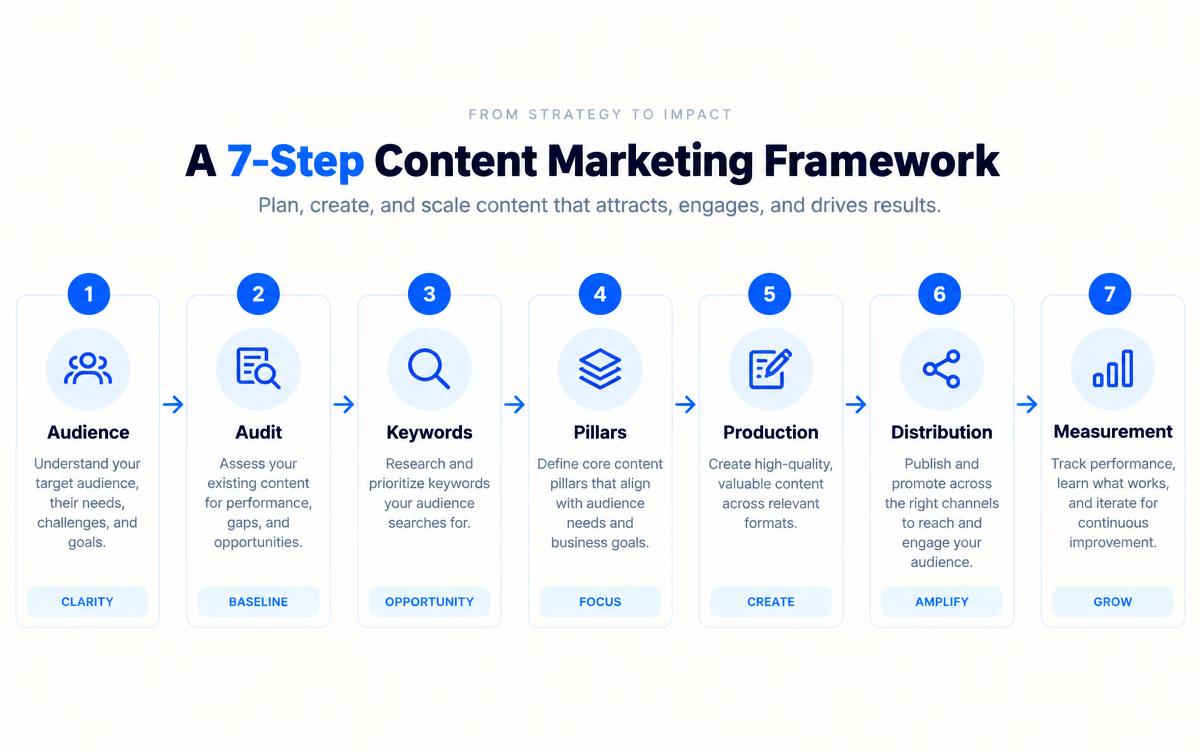
Step 3: Research demand, then filter it by intent
Keyword volume is an input, not a verdict. A term with 20,000 searches that attracts students and job seekers is worth less than one with 400 searches typed by someone comparing two vendors on a Thursday afternoon.
Score each candidate topic on three axes — search demand, commercial intent, and your genuine ability to say something new — and only build where at least two are strong. The third axis is the one most teams skip, and it is the one that decides whether a page gets cited by an AI assistant or deduplicated out of the answer entirely.
Signals worth more than raw volume
- Questions your sales team answers on repeat calls.
- Comparison and alternatives queries naming your competitors.
- Terms where the current top results are thin, dated or generic.
- Topics where you hold proprietary data, benchmarks or a documented process.
Step 4: Build pillars and clusters, not a list of posts
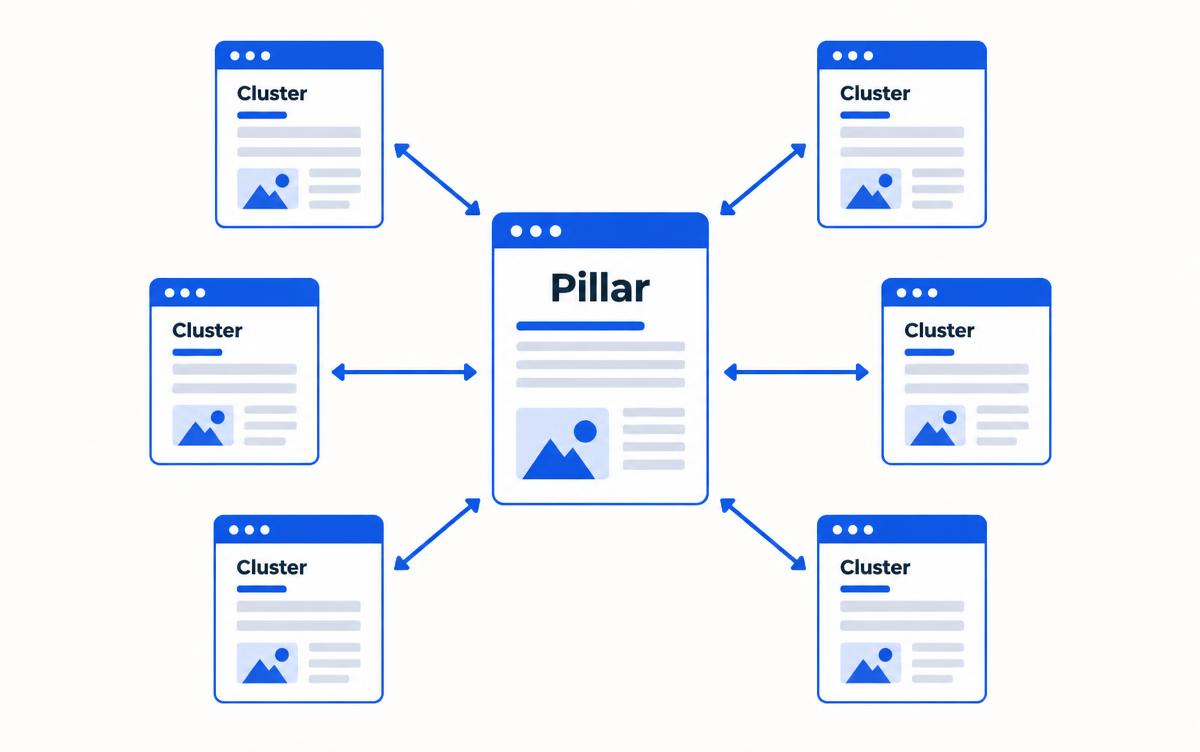
Choose three to five pillar topics you intend to own outright. Each pillar gets one comprehensive page plus five to eight supporting articles that answer a specific sub-question and link back to the hub, and sideways to each other.
This structure does two jobs at once. It signals topical authority to search engines, and it gives retrieval systems a dense, internally consistent set of passages to draw on. A single brilliant post floating on its own does neither.
Step 5: Produce for information gain
The production standard that matters in 2026 is information gain: does this page contain something a reader cannot get from the ten pages already ranking? Original numbers, a worked example with real figures, a documented method, a defensible opinion. Anything else is a summary of the index, and the index does not need another one.
Research from the Content Marketing Institute has consistently found that the highest-performing teams are distinguished less by budget than by two habits: a documented strategy and original research. Both are available to a five-person team.
A workable production standard
- Answer the question in the first hundred words, then add depth.
- Use H2s phrased the way a reader would type the question, and H3s for sub-answers.
- Attach a date to every statistic so it stays quotable and auditable.
- Include one original element per page — data, an example, a template, a process.
Step 6: Distribute deliberately
Publishing is not distribution. Every pillar should have a planned path to its first hundred readers: a newsletter send, a LinkedIn breakdown, a community post where the question actually gets asked, an outreach note to two or three people quoted in it.
Early engagement is also what earns the links and mentions that later make the page eligible to be cited in AI answers. The first fortnight after publication is worth more attention than most calendars give it.
Step 7: Measure influence, then hold your nerve
Replace the sessions dashboard with four numbers: content-influenced pipeline, the URLs that recur in closed-won journeys, self-reported attribution on forms, and how often your brand is named in AI answers for category queries.
Then give it time. Cluster-based programmes typically show movement at three to four months and compound from six. The single most common reason a sound strategy fails is that it is judged at week eight and quietly replaced by a new one.
Frequently asked questions
- What is a content marketing strategy?
- A content marketing strategy is a documented plan that defines who you are creating content for, which topics you intend to own, how those pieces connect, how they will be distributed, and which commercial outcome they are meant to influence. A publishing calendar without those decisions is a schedule, not a strategy.
- How do you create a content marketing strategy in 2026?
- Work through seven steps in order: define one audience and one commercial outcome, audit existing content, research demand filtered by intent, build three to five pillar clusters, produce for information gain, distribute each piece deliberately, and measure influenced pipeline rather than sessions.
- How long does a content marketing strategy take to show results?
- Expect early movement at three to four months and meaningful compounding from six, provided you publish in clusters rather than scattering unrelated posts. Newer domains sit at the longer end of that range.
- How much content should you publish each month?
- Depth beats frequency. One pillar page plus four to six tightly interlinked supporting articles per quarter, kept refreshed, outperforms a high-volume calendar of disconnected posts for almost every mid-market business.
- How much does a content marketing strategy cost?
- It depends on whether you are buying strategy alone or strategy plus production. Our monthly plans cover research, editorial strategy, production and optimisation together, starting at ₹9,990 a month, so you are not paying separately for a plan and the people who execute it.
Keep reading
Ready to build a content engine like this?
Book a strategy call or explore our plans.
Get new guides before they're announced.
One practical guide on SEO, AI search, and content strategy whenever we publish. Unsubscribe anytime.
Mohit Gupta
Mohit Gupta is an SEO growth strategist and content specialist with over 4.5 years of experience helping B2B/B2C and SaaS companies build organic visibility and revenue. He focuses on turning complex SEO, AI search, and positioning strategies into clear, actionable insights that drive real pipeline. When not writing about organic growth systems or decoding AI search trends, he is usually studying how the best companies get found without paid ads.