Schema Markup in 2026: The Complete Guide to Structured Data for SEO and AI Search
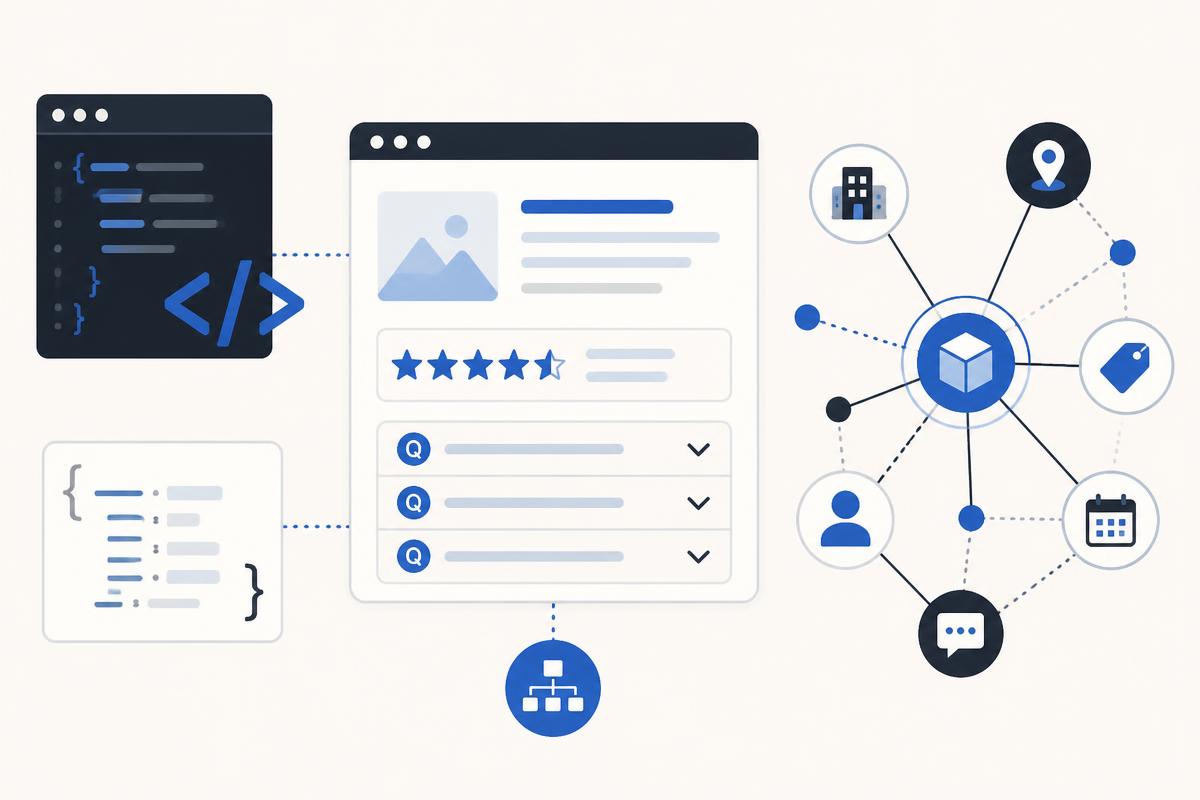
Around 4,400 people in India search for "schema markup" every month, and most of them are looking for the same thing: a plain answer to whether it is worth the effort. It is — but not for the reason most guides give. Schema markup does not make you rank higher by itself. It makes machines understand your page with certainty instead of guesswork, and in 2026 the machines reading your site include Google's crawler, AI Overviews, ChatGPT, Gemini and Perplexity.
That shift is what changed the maths. When search was ten blue links, structured data bought you a star rating or a breadcrumb. Now it is one of the few ways to tell an answer engine, unambiguously, what your business is, who wrote this page, what it costs and which questions it answers. This guide covers what schema markup is, the types that actually matter, how to implement and validate it, and the mistakes that get rich results revoked.
What schema markup actually is
Schema markup is standardised code you add to a page that labels its content for machines. It uses the shared vocabulary at Schema.org — a set of agreed-upon types such as Organization, Article, Product, FAQPage and LocalBusiness — so that a price is explicitly marked as a price, an author as a person, and a date as a publication date.
Without it, a crawler has to infer all of this from layout and language. Sometimes it infers correctly. Often it does not, especially on pages with tables, sidebars, testimonials and pricing toggles competing for attention. Structured data replaces inference with a declaration.
JSON-LD, Microdata and RDFa
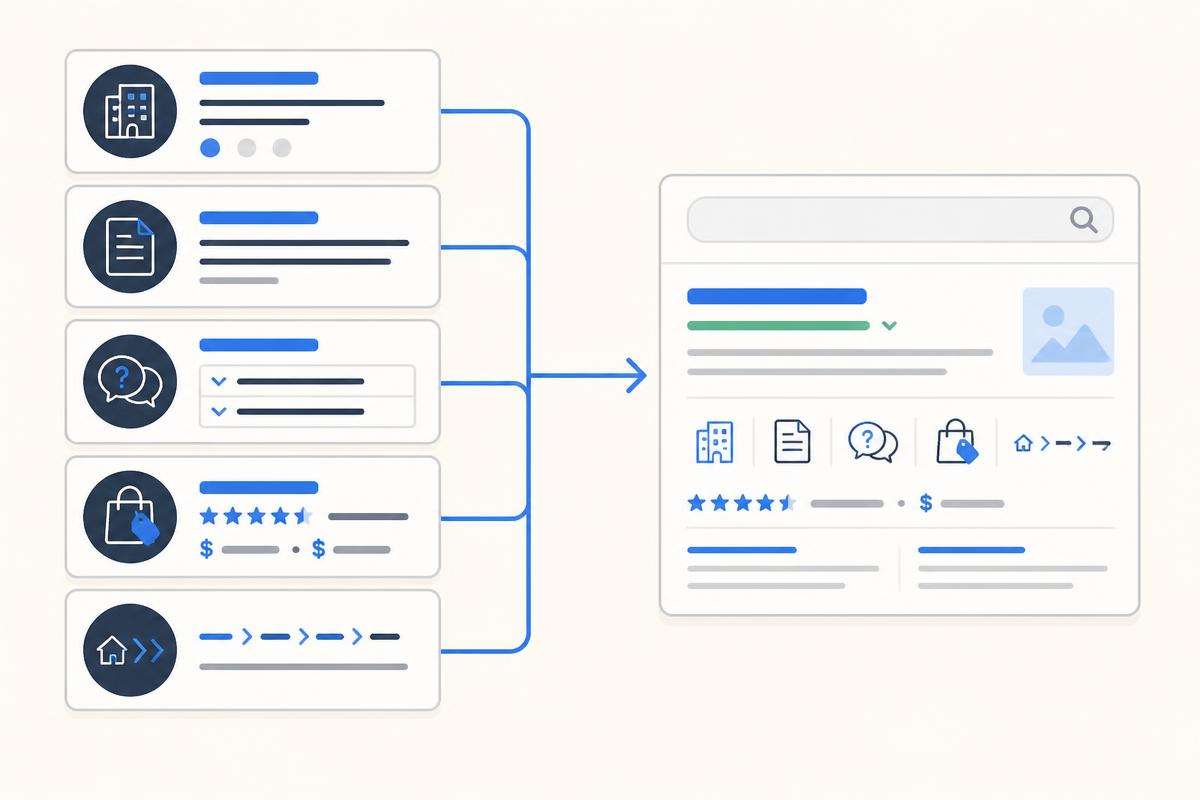
Three formats exist. Only one matters in practice: JSON-LD, a block of JavaScript Object Notation placed in a script tag in your page's head or body. Google explicitly recommends it, it lives separately from your visible HTML so it never breaks your design, and it is far easier to generate programmatically. Microdata and RDFa are legacy approaches that interleave attributes into your markup; do not start new work in either.
What it does and does not do
Schema markup is not a ranking signal. Adding FAQPage code to a thin page will not lift it. What it does is make your page eligible for rich results — review stars, FAQ dropdowns, product prices, sitelinks, event dates, recipe cards — and those change click-through rate, which is a very different lever from ranking position. It also feeds entity understanding: repeated, consistent Organization markup is how search systems learn that your brand is a distinct entity with a logo, a location and a set of services.
Why structured data matters more in AI search
AI answer engines have a harder job than a classic crawler. They are not ranking documents — they are extracting claims and attributing them. Every ambiguity in your page is a reason to quote a competitor instead, because the competitor's claim came with a clean, machine-readable label attached.
Structured data gives these systems three things they need: identity (this brand, this author, this organisation), facts (this price, this date, this rating) and structure (this is a question, this is its answer). A page whose FAQ section is marked up with FAQPage is a page whose questions and answers are already packaged in exactly the shape an answer engine wants to consume.
This is also why author and organisation markup has quietly become an E-E-A-T mechanism. If your author's credentials only exist as prose in a byline, they are an inference. If they exist as a Person entity linked to an Organization and a set of published articles, they are a declaration.
The schema types worth implementing
Most sites need five, not fifty. Start here and stop when you run out of things that are genuinely true about your pages.
- Organization — on every page, usually in a shared layout. Name, logo, URL, contact point, social profiles. This is the anchor for your brand entity.
- WebSite with SearchAction — enables sitelinks search box and tells engines your site has an internal search.
- Article or BlogPosting — for every editorial page. Include headline, author as a Person, datePublished and dateModified. The modified date is what signals a genuine refresh.
- FAQPage — for pages with a visible question-and-answer section. Eligible for expandable results and heavily used by AI engines for direct answers.
- BreadcrumbList — clarifies site hierarchy and replaces the raw URL in search results with a readable path.
- Product, Service or Offer — wherever you publish prices or packages, so the amounts are unambiguous.
- LocalBusiness — if you have a physical location or serve a defined geography. Keep the name, address and phone identical to your Google Business Profile.
How to add schema markup step by step
1. Decide the page type first
Every page gets one primary type and, where relevant, supporting ones. A blog article is an Article plus BreadcrumbList plus, if it has an FAQ section, FAQPage. A service page is a Service plus Organization plus BreadcrumbList. Deciding this before you write a line of code prevents the most common mess: three overlapping types describing the same entity differently.
2. Generate the JSON-LD
Use a schema generator for a first draft, or write it by hand — the syntax is short. Whichever route you take, populate it from the same source of truth as the visible page, not by retyping values. Hard-coded schema drifts out of date the first time someone edits a price.
3. Validate before and after publishing
Run the markup through Google's Rich Results Test and the Schema Markup Validator. The first tells you whether you qualify for a specific enhancement; the second tells you whether your syntax is valid at all. They answer different questions, so use both. After publishing, watch the Enhancements reports in Search Console — that is where Google reports errors it found on the live page, which is not always what your test environment produced.
4. Keep it in sync
Markup is only useful while it is true. Build it into your templates so new pages inherit it automatically, and audit quarterly for pages where the price, date, author or FAQ text has changed on screen but not in the code.
Mistakes that get rich results removed
Google issues manual actions for structured data spam, and they are recoverable but slow. Nearly all of them come from the same five errors.
- Marking up content that is not visible to users — the single most common violation. If a visitor cannot see the FAQ on the page, it must not be in FAQPage markup.
- Self-serving review markup: rating your own business or products with reviews you collected and control.
- Marking up irrelevant content — for example, tagging an entire article as a Product to chase price snippets.
- Mismatched values: schema price $299, page price $349. Any conflict makes the markup untrustworthy and the enhancement disappears.
- Duplicated or conflicting blocks after a plugin, a theme and a custom template all add their own Article schema to the same page.
Measuring whether it worked
Because schema markup does not move rankings directly, judge it on the right metrics. In Search Console, compare click-through rate for marked-up pages before and after implementation at the same average position — that isolates the effect of the enhancement from any ranking change. Track how many pages appear in the Enhancements reports without errors, and how quickly new pages get picked up.
For AI search, the measurement is different: monitor whether your brand is named and your facts quoted correctly in ChatGPT, Gemini, Perplexity and AI Overviews for your priority prompts. Correct attribution is the structured-data outcome that matters most now, and it is the one classic SEO reporting never captures.
If you want structured data built into every page as part of the content itself rather than bolted on afterwards, that is how we run technical implementation across our services — schema, internal linking and content architecture designed together.
A realistic implementation order
If you are starting from nothing, do it in this sequence: Organization and WebSite sitewide, BreadcrumbList across all templates, Article on the blog, FAQPage on the pages that genuinely have FAQs, then Product or Service on commercial pages. That order front-loads entity clarity — the part AI engines depend on — before chasing individual rich result types.
The whole job is usually a week of work for a mid-sized site and then a quarterly review. For a technical investment with that little ongoing cost, the comprehension it buys from both Google and AI engines is hard to beat.
Frequently asked questions
- What is schema markup in SEO?
- Schema markup is standardised code, usually written in JSON-LD, that labels the content of a page using the Schema.org vocabulary. It tells search engines exactly what each element is — a price, an author, a review, a question — instead of leaving them to infer it from the layout.
- Does schema markup help SEO rankings?
- Not directly. Schema markup is not a ranking factor. It makes pages eligible for rich results such as FAQ dropdowns, review stars and breadcrumbs, which typically improve click-through rate at the same ranking position, and it helps search and AI systems understand your brand as an entity.
- Which schema type should I use for a blog post?
- Use Article or BlogPosting, with the author as a Person, plus datePublished and dateModified. Add BreadcrumbList for hierarchy, and FAQPage if the article contains a visible question-and-answer section — as this one does.
- How do I check whether my schema markup is working?
- Test the code with Google's Rich Results Test to confirm enhancement eligibility and the Schema Markup Validator to confirm the syntax is valid. Then monitor the Enhancements reports in Google Search Console, which report errors found on the live page after crawling.
- Does schema markup help my content get cited by AI engines?
- It helps considerably. Answer engines need to attribute claims to a clearly identified source, and structured data supplies unambiguous identity, facts and question-answer pairs. It works best alongside a proper answer-engine strategy — see our guide to AEO content strategy for AI answers.
Keep reading
Ready to build a content engine like this?
Book a strategy call or explore our plans.
Get new guides before they're announced.
One practical guide on SEO, AI search, and content strategy whenever we publish. Unsubscribe anytime.
Mohit Gupta
Mohit Gupta is an SEO growth strategist and content specialist with over 4.5 years of experience helping B2B/B2C and SaaS companies build organic visibility and revenue. He focuses on turning complex SEO, AI search, and positioning strategies into clear, actionable insights that drive real pipeline. When not writing about organic growth systems or decoding AI search trends, he is usually studying how the best companies get found without paid ads.